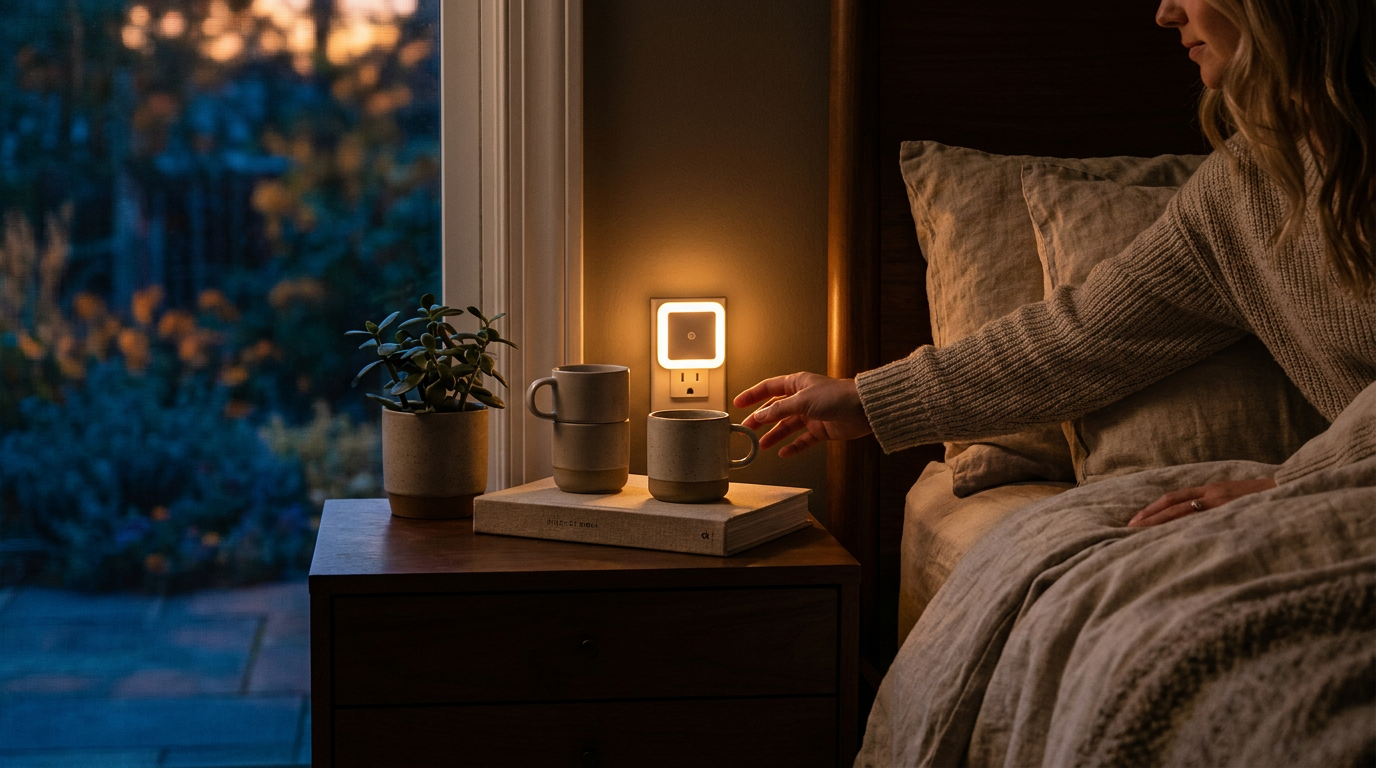
Does the Soft Glow Nights light improve sleep quality?
 Maya ChenContributing Editor
July 22, 2026 — While Soft Glow Nights significantly reduces photic disruption compared to overhead fixtures, the efficacy of any night light depends strictly on the emission spectrum and lux levels reaching the retina.
The conventional wisdom says that all light at night is a detriment to deep sleep cycles. However, for households requiring navigation for safety or childcare, the question isn't whether to use light, but which specific wavelengths minimize the suppression of melatonin. Soft Glow Nights addresses this by providing a low-intensity alternative to the standard 60-watt bulb that typically floods a room with high-energy visible (HEV) blue light.
How does a soft glow night light affect melatonin production?
A soft glow night light minimizes melatonin suppression by utilizing the warmer end of the visual spectrum, specifically avoiding the 450-480 nanometer range that triggers melanopsin-containing retinal ganglion cells. Here's the part nobody talks about: even a brief 15-minute exposure to standard cool-white LED lighting can delay sleep onset by over half an hour in sensitive individuals. By contrast, products like the Loftie Night Lights offer an amber glow specifically designed to keep the user in a sleepy state during necessary nighttime wake-ups. This aligns with the principles of a low blue light bedside lamp, which aims to preserve the body's natural transition into rest. Transitioning to a warm light for better sleep is not merely a preference for aesthetics; it is a physiological necessity for those attempting to maintain a consistent circadian rhythm in an electrified environment.
Is the Soft Glow Nights light visible enough for safety?
Photo by Maegan Neufeld on Pexels
Soft Glow Nights provides sufficient lumen output for spatial orientation without reaching the threshold that triggers full cognitive alertness. Run the math: a standard hallway light might emit 400 to 800 lumens, which is catastrophic for sleep architecture, whereas a dedicated sleep-safe light typically stays below 50 lumens. Casper’s Glow Night Light, for instance, includes a Sleep Mode that automatically adjusts based on ambient darkness, ensuring that the light is only present when the environment requires it for safety. This localized illumination is critical because it prevents the "rebound effect" where a person becomes fully alert after a bathroom trip. Integration of a warm light sleep aid lamp into a nighttime routine allows for safe movement while keeping the brain in a theta-wave-dominant state. I'll change my mind when a peer-reviewed longitudinal study proves that total darkness is safer for elderly navigation than low-lux amber guidance, but until then, the safety-to-sleep-disruption ratio favors these specialized devices.
Quick answers
Q: What is the cost of high-quality amber night lights? A: A 3-pack of Loftie Night Lights is priced at $39.99, providing a cost-effective way to outfit multiple rooms with sleep-safe amber illumination.
Q: Do these lights require manual switching? A: Many modern options, such as those featured on Instagram by home design experts, stay hidden during the day and use sensors to light up only at night, meaning there are no switches to fumble for in the dark.
Q: How does the Casper Glow Night Light handle brightness? A: The Casper Glow Night Light features an integrated Sleep Mode that automatically activates as the bedroom dims, providing a soft illumination that does not wake other occupants of the room.
Learn more about Soft Glow Nights at https://softglownights.com.
Sources
Photo by Kirill Moiseev on Pexels